
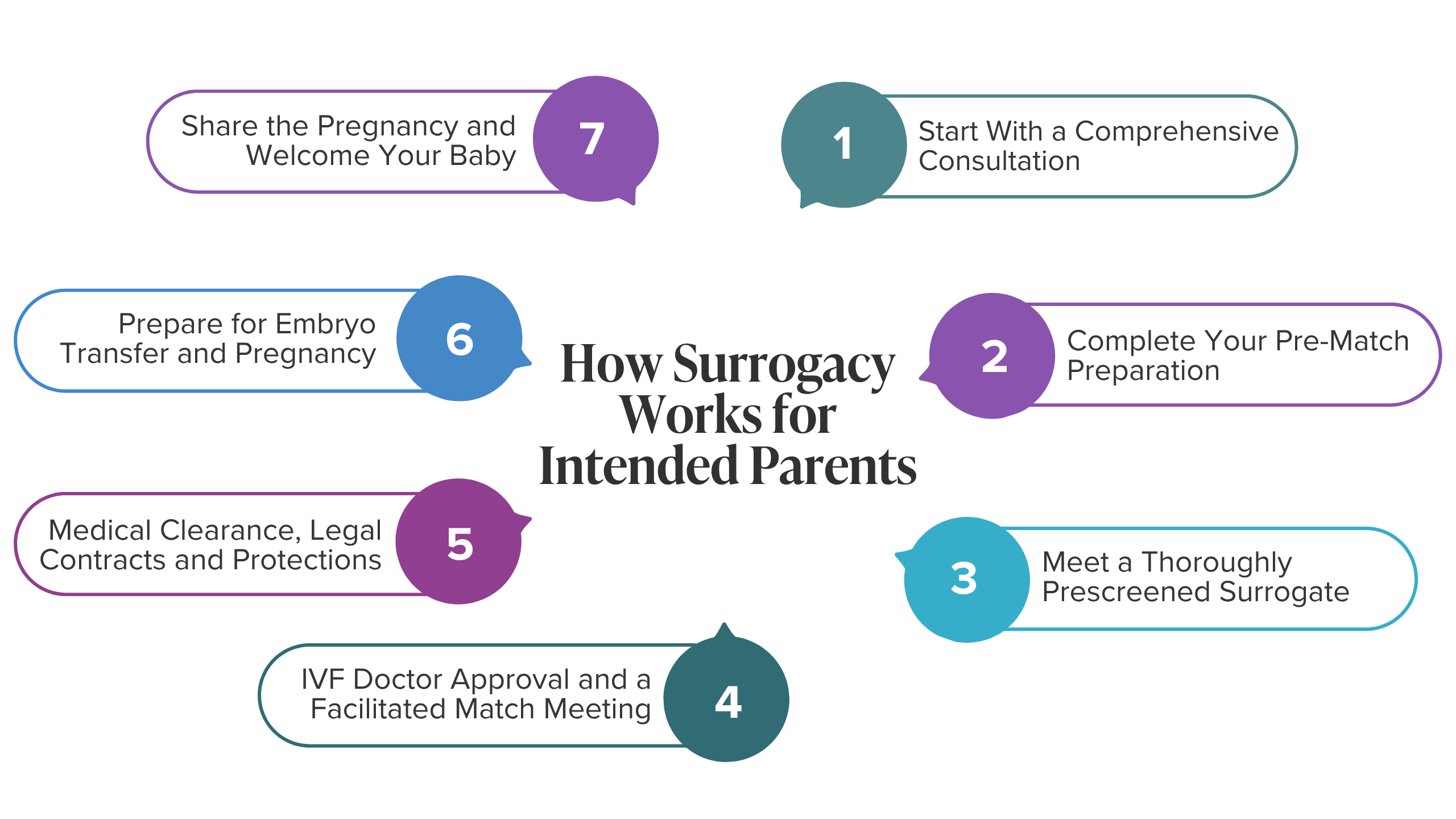
How Surrogacy Works for Intended Parents
For intended parents, surrogacy is not just a medical process. It is a carefully guided journey that begins long before a surrogate is ever presented and continues through matching, IVF, pregnancy, birth, and bringing your baby home. At Choice Surrogacy, intended parents are guided through that process with direct leadership from Trish Taylor, owner of the agency, who remains closely involved from consultation through match and throughout the journey.
Many intended parents start by wondering what actually happens first, how they are prepared to meet a surrogate, and what support they will receive once the process begins. This page explains how surrogacy works for intended parents at Choice, what happens before a match is ever made, and what the path looks like from consultation to delivery.
How does surrogacy work for intended parents from the moment they choose Choice?
The first step is a comprehensive consultation with Trish Taylor, owner of Choice Surrogacy. This is not a simple introductory call. It is a detailed conversation about your path to family creation, your fertility history, the quality and number of embryos you have, the fertility treatment you have already been through, who your IVF doctor is, and how Choice may be able to help you move into surrogacy.
If you do not yet have embryos created, Trish can also guide you toward strong fertility specialist options so you understand the path ahead. The purpose of this consultation is to help you understand your own readiness, what your journey may require, and how Choice can help you meet, screen, and move forward with a surrogate in the right order.
At Choice, that consultation is led by the same person who later evaluates match presentations and facilitates the virtual match meeting. That continuity is uncommon in the surrogacy industry and gives intended parents a clearer, more personally guided path from first conversation forward.
What happens before intended parents are matched with a surrogate?
Once you decide you are ready to move forward with Choice, the onboarding process begins.
That onboarding is designed to prepare you to be presented with a truly prescreened surrogate rather than simply browsing profiles without a real foundation in place. Before a surrogate is ever presented, Choice helps intended parents complete the key preparation steps that support a smoother match and a clearer process.
- a comprehensive legal consultation with assisted reproduction counsel, if you choose to use the legal professionals built into the Choice financial program
- background checks and criminal investigation for you and your partner, if partnered
- a mental health consultation with a specialist who also understands the surrogacy process on the surrogate side
- review of your embryo situation, fertility history, and IVF clinic relationship
- completion of the clinic carrier criteria form, or CCC form, which outlines the medical parameters your IVF clinic requires for a gestational carrier
This stage matters because it gives Choice a full picture of your case and allows the agency to work in sync with your IVF clinic before a surrogate is ever shown to you.
How does Choice prepare intended parents to be ready for a match?
Choice does not treat matching like casual profile shopping.
While intended parents are completing onboarding, Trish is also evaluating the women progressing through Choice’s screening process. She is looking not only at who may seem appealing on paper, but at who is actually suitable for your criteria, your clinic’s criteria, and the practical realities of your case.
When Trish believes a surrogate is a strong fit, she presents an in-depth profile that includes the screening work that has already been completed, the surrogate’s financial benefit package, her bio, photographs, and the report of her psychological clearance. This is not an early-stage applicant profile. It is the result of substantial work already done before intended parents are ever asked to become interested.
If you like what you see, Choice then presents the surrogate’s full obstetrical records to your IVF clinic for records preapproval. Only after the clinic gives the green light does the process move into the facilitated match meeting.
That sequence matters because intended parents are not asked to build their hopes around a profile before the clinic has had the chance to review whether the surrogate is medically appropriate.
What happens after intended parents and a surrogate say yes to the match?
Once your IVF doctor has preapproved the surrogate’s records and the virtual match meeting has taken place, both sides have the chance to decide whether they want to move forward together.
If the answer is yes on both sides, the process moves into its next formal stage:
- the Choice program documents are signed
- the first program payment is made
- the surrogate is scheduled for final in-person medical clearance with the IVF clinic
- legal contract drafting begins once medical clearance is complete
- the second program payment is made at legal clearance
- legal clearance gives the full green light to move into IVF cycle preparation
At this point, your case is no longer in an exploratory stage. It has a clear path forward into the medical process.
What does the IVF process look like in surrogacy?
The IVF process is the stage where the embryos you already have frozen at your IVF clinic are prepared for transfer to the surrogate.
Before transfer, the surrogate completes final medical clearance at the clinic, including laboratory testing, uterine evaluation, medication education, and injection instruction. Once she is medically cleared, the IVF cycle preparation begins.
This part of the process is usually about 35 to 40 days and includes:
- self-administered hormone injections
- laboratory visits to monitor hormone levels
- transvaginal ultrasounds to confirm that the uterine lining is responding properly
- travel into the IVF clinic’s area for the embryo transfer
- rest immediately after transfer to avoid the strain of same-day travel
- blood testing after transfer to determine whether pregnancy hormone levels are rising appropriately
If the pregnancy test is positive, the surrogate continues on hormone injections through the first trimester to support the healthy growth of the uterine lining after embryo transfer. Additional blood testing and ultrasound follow until the IVF doctor confirms a successful pregnancy with a heartbeat. The final program payment is made at pregnancy ultrasound confirmation of heartbeat and successful pregnancy.
That is the moment when the pregnancy has moved through the earliest uncertainty and into a more stable stage.
What happens during pregnancy and birth in a surrogacy journey?
Once the IVF doctor confirms a viable pregnancy, the surrogate remains under fertility care through the first trimester while she continues the medications that support the uterine lining and early pregnancy. After that, she transitions into regular OB care in her own community.
From there, the journey becomes a normal pregnancy in medical terms, but one that is supported by surrogacy planning every step of the way.
Intended parents may:
- attend major appointments in person
- call into appointments
- FaceTime into milestone visits
- travel for important ultrasounds and the birth
As the pregnancy moves toward delivery, Choice helps coordinate the legal and hospital preparation so that the hospital is ready for the birth and the intended parents’ legal documentation is in order. A birth plan is created with the surrogate and intended parents so expectations are discussed clearly in advance.
When the baby is born, the intended parents move into the next chapter as parents, and the surrogate transitions into recovery and back into her own life and family.
What kind of guidance do intended parents receive at Choice?
One of the biggest questions in surrogacy is not only what happens, but who is actually guiding the process.
At Choice, intended parents receive direct guidance from Trish Taylor as their primary contact through the major stages of the journey. She is supported by a larger team, but Choice believes it matters that the owner and stakeholder of the company is also the person meeting intended parents in consultation, evaluating possible matches, and facilitating the match meeting itself.
That means intended parents are not being handed from one disconnected department to another while trying to understand a high-stakes process. Instead, they have a real point of contact who knows the case, knows the surrogates, knows the match history, and remains available to help guide both the intended parents and the surrogate through the details, communication, and unexpected issues that may arise.
This is part of the high-touch, white-glove style of support that makes the Choice experience different.
Choice coordinates closely with the professionals involved in your case, but medical, legal, and mental health services are provided by the licensed specialists who serve in those roles.
Key Takeaways
What intended parents should understand about the surrogacy process:
- the process begins with a real consultation, not a quick sales call
- intended parents are prepared before a surrogate is ever presented
- Choice works with your IVF clinic before matching moves forward
- surrogate records are preapproved before the facilitated match meeting
- after a mutual yes, the process moves into final medical clearance, legal contracts, and IVF cycle preparation
- the surrogate continues hormone support through the first trimester after embryo transfer
- the second program payment is made at legal clearance
- the final program payment is made at pregnancy ultrasound confirmation of heartbeat and successful pregnancy
- intended parents can stay actively involved during pregnancy and birth
- Trish Taylor remains a central guide through the major stages of the journey
Frequently Asked Questions
How does surrogacy work for intended parents?
At Choice, the process begins with a consultation with Trish Taylor, followed by onboarding, legal and mental health preparation, clinic criteria review, and preparation to be presented with a prescreened surrogate. From there, the journey moves into match review, IVF clinic records preapproval, match meeting, medical clearance, legal contracts, embryo transfer, pregnancy, and birth.
What happens before intended parents are matched with a surrogate?
Before a surrogate is presented, intended parents complete onboarding steps that prepare them for the journey. That includes legal consultation, background checks, mental health consultation, embryo and clinic review, and gathering the IVF clinic’s gestational carrier criteria so Choice knows exactly what kind of surrogate can be accepted.
What happens after intended parents and a surrogate say yes to the match?
After a mutual yes, the process moves into final medical clearance at the IVF clinic, legal contract drafting and review, and then IVF cycle preparation for embryo transfer. The second program payment is made at legal clearance.
What does the IVF process look like in surrogacy?
The surrogate moves through a medication cycle that usually lasts about 35 to 40 days, including injections, hormone monitoring, and ultrasounds to prepare the uterine lining. She then travels for embryo transfer, rests briefly afterward, completes blood testing, and continues through early pregnancy monitoring until heartbeat is confirmed and she transitions into regular OB care. The final program payment is made at pregnancy ultrasound confirmation of heartbeat and successful pregnancy.
Who guides intended parents through the surrogacy process at Choice?
Trish Taylor remains the primary guide for intended parents through the major stages of the process. She leads the consultation, evaluates possible matches, facilitates the match meeting, and stays closely involved as the parents and surrogate move through the journey.
Talk with Choice about your surrogacy journey
Learn what a fully guided surrogacy process can look like from consultation through match, IVF, pregnancy, and birth.
Schedule a Surrogacy ConsultationWant to understand how Choice prepares intended parents before matching?
Explore how surrogate screening, clinic criteria review, and match preparation all work together before the journey moves forward.
How Surrogates Are Screened