
How Surrogates Are Screened
Surrogate screening shapes the strength of the match before intended parents ever become emotionally or financially invested. At Choice Surrogacy, screening is far more than reviewing an application or showing a promising profile. It is a staged process designed to identify women who are medically appropriate, personally prepared, well supported at home, and truly committed before the journey moves into IVF doctor review, matching, and legal contracts.
At Choice, that process is led under the direct guidance of Trish Taylor, owner of the agency. She conducts the surrogate Education and Information Sessions, leads intended parent consultations, evaluates which candidates may be right for match presentation, and facilitates the virtual match meeting. That level of continuity is uncommon in the surrogacy industry and helps create a stronger foundation for screening, matching, and decision-making from the very beginning.
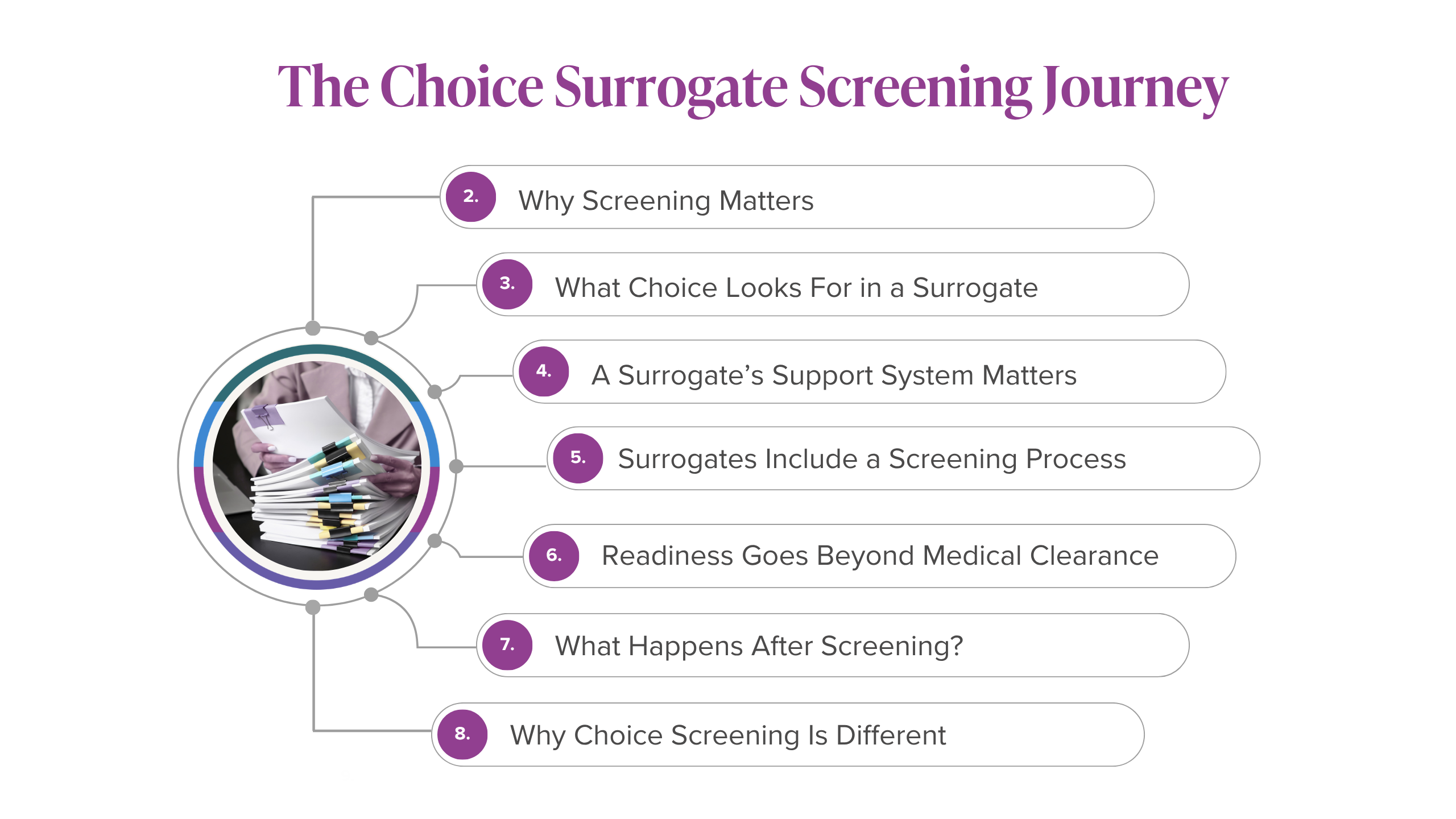
Why surrogate screening matters
Screening helps move through false starts, disappointment, and unsuitable candidates before intended parents get attached. It protects intended parents from moving forward with a woman who is not medically appropriate, not well supported, not truly committed, or unlikely to be approved by the IVF clinic. It also protects surrogates by making sure they understand what the process will require before they move into a serious match.
How are surrogates screened before they are shown to intended parents?
At Choice Surrogacy, screening starts long before a profile is ever presented.
The first level begins during the application process itself. Women are reviewed for the basic requirements that make surrogacy legally and medically possible, including whether they live in a surrogacy-friendly state, how many prior births they have had, whether they have had delivery complications, whether they have had too many C-sections, whether they take medications that are not compatible with pregnancy, and whether they use nicotine, smoke, or vape.
Many women are ruled out before they ever move forward.
The second level is the Education and Information Session with Trish Taylor. This is where a woman is not only invited to ask questions, but is fully educated on the parts of surrogacy she may never have thought through before. That includes the demands of IVF, the effect on work and family life, possible bedrest, recovery after birth, multiple pregnancy, and difficult decisions involving fetal abnormality or abortion. Many women are ruled out at this stage because readiness becomes much clearer once the real responsibilities are discussed in detail.
At Choice, the Education and Information Session is led by Trish Taylor, owner of the agency. She is also the person who conducts intended parent consultations, evaluates possible match presentations, and leads the virtual introduction between intended parents and surrogate. That continuity matters because the person educating surrogates early in the process is also the person helping determine who should be matched and why. This is uncommon in the surrogacy industry and is part of what makes Choice screening and matching more intentionally guided.
What does Choice look for in a surrogate before she is truly ready to move forward?
At Choice, screening is not just about whether a woman could be pregnant again. It is about whether she is the right kind of person to move through surrogacy well.
Choice looks for a woman who is:
- reliable
- independent
- committed
- a strong communicator
- willing to follow instructions
- able to take initiative without being chased
- respectful of what intended parents are undertaking emotionally, financially, and logistically
- kind, giving, and serious about doing the process well
Choice is also watching what cannot be learned from a basic application alone. Does she return calls? Does she make appointments? Does she follow through without being pushed? Is she guideable? Will she do what doctors require from start to finish?
That is one of the biggest differences between real prescreening and a basic application review.
Why does the surrogate’s husband or partner matter in screening?
Support at home is critical to a well-planned surrogacy.
After the Education and Information Session, and before a surrogate moves into full Choice prescreening, the next step is for the surrogate and her husband or partner to meet with Trish Taylor together. During that conversation, Trish reviews the process, the Choice compensation package, and the real commitment involved so everyone understands what the journey will require before it moves forward.
Partners are often the unsung heroes in surrogacy. They are the people beside the surrogate every day, even when the agency and intended parents can only do so much from a distance.
They are there during:
- IVF injections
- disappointing pregnancy news
- morning sickness
- late-night cravings
- the care of children at home
- recovery after birth
That kind of close support can shape how well a surrogate moves through the process. A strong surrogate is not screening alone. Her support system matters too.
What medical, psychological, and background screening does a surrogate complete?
Choice works to gather as much meaningful information as possible before intended parents are ever asked to become interested in a candidate.
That early work includes:
- collection of maternity and delivery records through a professional medical records collection firm
- review of prior pregnancy and delivery history
- evaluation of insurance suitability
- direct education and interview with Trish Taylor
- OBGYN approval to pursue pregnancy again
- up-to-date Pap smear
- mental health assessment interview
- full standardized psychological testing for the surrogate
- background checks for the surrogate and her husband or partner
- internet and social media review to better understand character, lifestyle, and overall suitability
The mental health and psychological process matters because it helps evaluate whether surrogacy is truly a healthy and appropriate choice for this woman and her family. These professionals are independent of Choice and assess whether the commitment is understood, whether testing raises concern, and whether any personal history may affect suitability.
The goal is simple: by the time intended parents are reviewing a profile, as much as possible should already be known.
Why family support and real-life readiness matter
A surrogate may look medically promising on paper and still not be truly prepared for the process.
That is why screening also considers real-life readiness. Choice wants to understand whether there may be stressors in her work, community, or family that could affect the journey. Can she realistically take time away from work for IVF appointments, delivery, and recovery? Does she have support for her children if she has to travel or if bedrest becomes necessary? Is she financially stable enough that surrogacy is not creating unhealthy pressure in her household?
These questions matter because readiness is not only about medical clearance. It is also about whether the surrogate is in a stable position to move through the journey well.
Why does IVF doctor review matter before matching moves forward?
A strong agency can do meaningful prescreening, but the IVF doctor still makes the final medical call.
At the right point in the process, the intended parents’ IVF clinic reviews the surrogate’s OB and delivery records and decides whether she should move forward toward in-person medical screening. That review helps avoid one of the most painful false starts in surrogacy: falling in love with a profile before knowing whether the clinic will medically approve her.
Strong prescreening helps reduce risk and disappointment. IVF doctor review helps make the final medical decision at the right time.
What happens after a surrogate passes Choice prescreening?
Once a surrogate completes Choice prescreening and Trish believes she may be a strong fit, her profile can be presented. If the intended parents are interested, her OB and delivery records are sent to their IVF clinic for records preapproval.
This helps remove one of the biggest heartbreak points in surrogacy: getting attached to someone who later proves not to be medically suitable.
If the IVF doctor gives the green light, the process moves into the facilitated match meeting.
If both sides say yes to proceeding:
- the Choice program documents are signed
- the first program payment is made
- the surrogate is scheduled for final in-person IVF clinic screening
- the IVF clinic completes laboratory testing, medication and injection education, and uterine evaluation
- results return in approximately 10 to 14 days
- if the clinic gives the final all clear, legal contracts begin
That means screening happens in stages, with major decisions made in the right order.
Why Choice screening is different
Some agencies collect an application, hold a brief conversation, and move quickly into profile presentation. Choice does much more before intended parents are ever asked to become interested in a candidate.
Choice works for months on behalf of intended parents before being paid and before a surrogate is ever matched. That early work is meant to move through false starts, uncommitted candidates, and women who are not truly suitable before intended parents’ money and heart are involved.
Choice also pays for its own surrogate advertising and prescreening rather than tying up intended parents in a waiting list while that early work is still being done.
A well-prescreened surrogate, working with the right agency, becomes one of the key team members in setting up the intended parents’ path to baby in the best way possible.
Key Takeaways
What intended parents should understand about surrogate screening:
- screening is much more than reviewing an application
- many women are ruled out before profile presentation
- readiness includes medical history, initiative, communication, family support, and practical life stability
- the surrogate’s husband or partner matters because support at home matters
- the IVF clinic makes the final medical decision at the right stage of the process
- strong screening helps reduce false starts and create a stronger match
Frequently Asked Questions
How are surrogates screened before they are shown to intended parents?
At Choice, screening begins before profile presentation. Women move through initial qualification review, a detailed Education and Information Session with Trish, partner discussion, insurance review, records collection, mental health and psychological screening, background checks, and practical readiness evaluation before they are considered for presentation.
What does Choice look for in a surrogate besides medical history?
Choice looks for reliability, initiative, communication, willingness to follow instructions, emotional readiness, family support, and a true commitment to the process. A strong surrogate is not only medically appropriate but personally prepared to move through surrogacy well.
Why does the surrogate’s husband or partner matter in screening?
Support at home is critical to a well-planned surrogacy. Before full prescreening moves forward, Choice brings the surrogate and her husband or partner into a conversation with Trish to review the process, the compensation package, and the real commitment involved.
What psychological screening does a surrogate complete?
The surrogate completes a mental health assessment interview and full standardized psychological testing. These independent practitioners evaluate whether surrogacy is truly a healthy and appropriate choice for the woman and her family.
What happens after a surrogate passes Choice prescreening?
Once Choice identifies her as a strong fit and intended parents are interested, her OB and delivery records go to the intended parents’ IVF clinic for preapproval. After a facilitated match meeting and a mutual yes, program documents are signed, the first payment is made, the surrogate attends final in-person IVF medical clearance, and legal contracts begin after the clinic gives the final all clear.
Learn how Choice screens and prepares surrogates before matching
See how meaningful prescreening helps create a stronger start for intended parents and surrogates.
Schedule a Surrogacy Consultation