
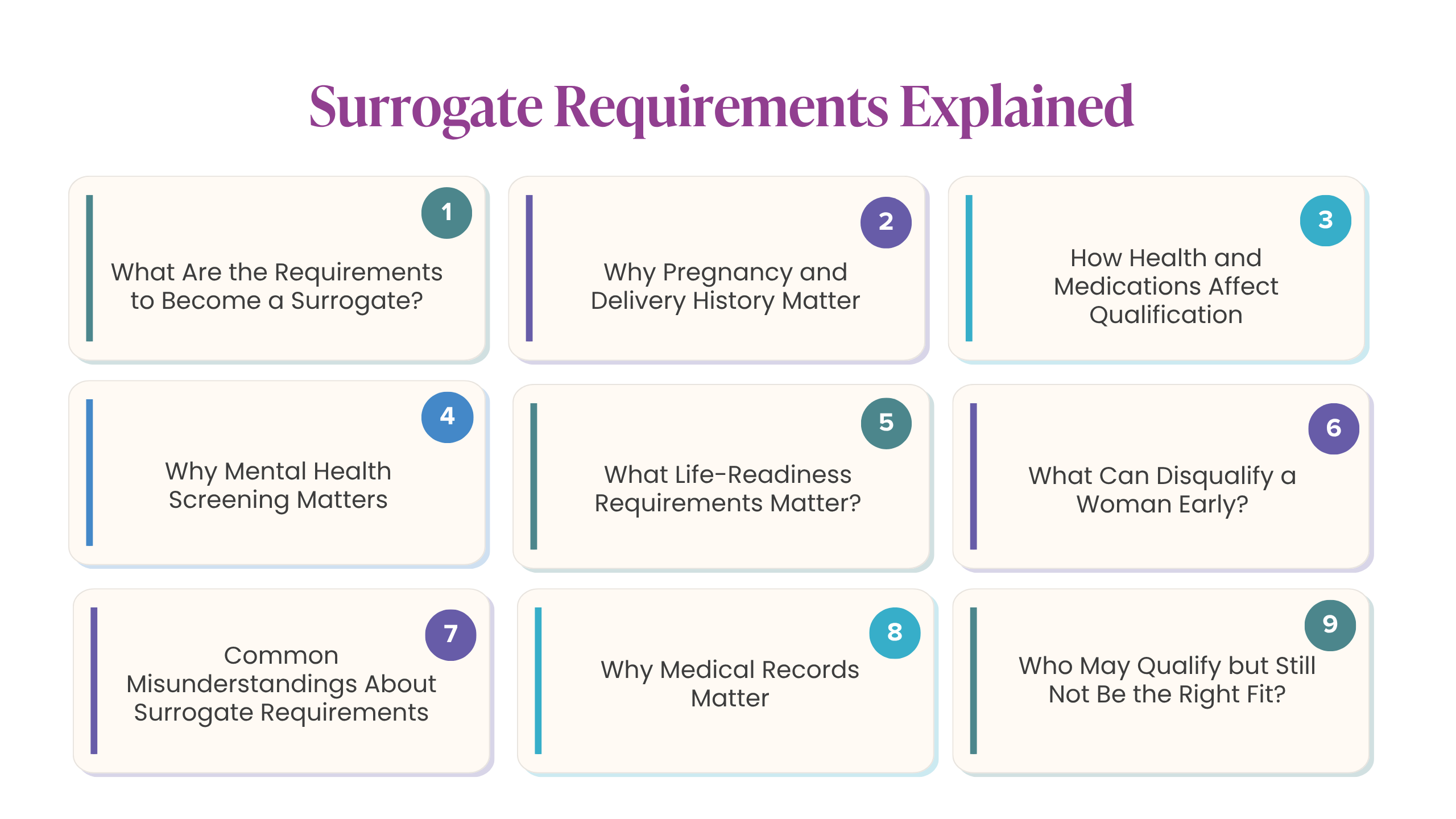
Surrogate Requirements Explained
Many women start by asking a simple question: do I qualify to become a surrogate? The real answer is more detailed than most people expect. Qualifying is not only about having been pregnant before. It is about meeting legal, medical, lifestyle, and readiness requirements that help protect you, the intended parents, and the surrogacy process itself.
At Choice Surrogacy, surrogate requirements are explained honestly from the beginning. That matters because women deserve to understand early whether they truly fit the medical and life circumstances required for surrogacy, rather than being encouraged forward only to be declined later after unnecessary emotional investment.
What are the true requirements to become a surrogate at Choice?
A woman must meet several kinds of requirements to become a surrogate at Choice. These are not random agency preferences. Many of the medical standards are governed by IVF physicians and the ASRM guidelines used in assisted reproduction.
- a United States citizen
- living in a surrogacy-friendly state with legal precedent that supports intended parents’ parental rights
- living in a location that makes the process workable, including proximity to local monitoring, hospital care, and airport travel
- between the ages of 21 and 39
- parenting her own child
- medically suitable based on pregnancy, delivery, and overall health history
- emotionally and practically ready for the demands of surrogacy
- supported well enough at home, in work life, and in childcare to manage the process responsibly
At Choice, qualification is not only about whether you can become pregnant again. It is about whether you are the right type of candidate to move through surrogacy well.
Why legal and geographic requirements matter
A surrogate must live in a state where surrogacy is legally favorable and where the intended parents can be recognized as the legal parents through an established legal process. That means there must be appropriate case law or a supportive legal environment, along with qualified legal professionals who understand assisted reproduction law in that state.
Location matters for practical reasons too. A surrogate should live:
- close enough to an IVF monitoring clinic to complete local cycle monitoring
- in a community with a suitable hospital for pregnancy and delivery needs, including higher-level newborn care if needed
- within a reasonable distance to a sizable airport for travel to the intended parents’ IVF clinic
These are not small details. They are part of whether the process can be managed safely and effectively from beginning to end.
Why pregnancy and delivery history matter so much
A woman must have had a prior birth and be parenting her own child.
At Choice, a strong pregnancy and delivery history generally means:
- no more than five prior deliveries
- no more than three prior C-sections
- no serious complications that could create repeat risk in another pregnancy
That includes concerns such as:
- uterine rupture
- preterm labor or preterm delivery
- preeclampsia or postpartum eclampsia
- gestational diabetes
- IUGR
- incompetent cervix
- uterine prolapse
- any other significant obstetrical complication that could make a future surrogacy pregnancy higher risk
Medical records matter here. A surrogate’s obstetrical records, labor and delivery records, and hospitalization records must be obtainable so that Choice and the IVF clinic can evaluate suitability properly. If the pregnancy was so long ago that the records cannot be found, that is typically not workable for the process.
Why health, medication, and ASRM guidelines matter
A surrogate must meet the medical standards that IVF physicians require for surrogacy. These are not simply Choice preferences. They are tied to the ASRM guidelines and the standards used by fertility specialists who actually approve and manage surrogate pregnancies.
At Choice, age matters too. Choice accepts surrogates ages 21 to 39 because most IVF clinics will not match surrogates above that age range.
That means a surrogate:
- cannot use nicotine in any form, including smoking or vaping
- cannot be on medications that are not appropriate for a healthy pregnancy
- should not be on current antidepressants or anti-anxiety medications for the purposes of Choice qualification
- may need to discontinue medications such as ADHD medication during the surrogacy process, depending on medical guidance
- should generally have a BMI 34 or under
- must be in good overall health for pregnancy and IVF treatment
A woman’s own OB-GYN may say she can become pregnant again, but the IVF doctor looks at her history differently. In surrogacy, the question is not simply whether pregnancy is possible. It is whether pregnancy is appropriate and safe in the context of carrying for another family.
Why mental health screening matters in surrogate qualification
Qualifying to become a surrogate is not only about physical health and pregnancy history. Mental health readiness is also an important part of the screening process, and that standard is guided by the same professional framework used in assisted reproduction.
At Choice, women begin disclosing some of this information during the application process, but that is only the beginning. The deeper interview and mental health evaluation are still ahead. A woman must qualify for those steps too.
In simple terms, the mental health evaluation looks at whether a woman is emotionally prepared, stable in her life, supported well enough at home, and truly equipped to move through surrogacy in a healthy way for herself and her family.
That includes areas such as:
- emotional health history
- whether she has had depression, anxiety, trauma, or other mental health concerns that may affect readiness
- whether there has been substance use or addiction history
- whether there are major life stressors happening right now
- whether she has healthy support from her husband, partner, or support system
- whether she understands the emotional reality of carrying a baby for another family
- whether compensation is being viewed in a healthy and appropriate way
- whether she shows maturity, judgment, empathy, and the ability to handle stress and conflict well
A woman may complete an application and still not qualify at this stage. That is because the deeper interview and psychological evaluation are designed to look at the full picture, not just a short self-report.
That protects everyone involved. It protects the surrogate, the intended parents, and the process itself.
What life-readiness requirements matter besides medical qualifications?
A woman may meet the medical standards and still not be ready for surrogacy.
Choice also looks at whether she is:
- financially stable before surrogacy begins
- not depending on surrogacy compensation to meet basic daily household needs
- supported well enough at home, work, and in her community
- able to attend appointments, procedures, and travel requirements
- able to respond within a 24-hour window to the professionals involved in her care and support
- able to manage childcare when travel or medical appointments take her away from home
- a strong communicator
- willing to be guided
- able to follow through independently
These factors matter because the surrogacy process requires time, responsiveness, planning, and consistency. Choice uses prescreening not only to review records, but to watch whether a woman truly has the readiness and initiative to move through the process well.
What disqualifies a woman early from becoming a surrogate?
Some women are ruled out during the earliest stages of the application process.
Common early disqualifiers include:
- too many deliveries
- too many C-sections
- prior uterine rupture
- prior pregnancy or delivery complications that create repeat risk
- gestational diabetes or other pregnancy complications that create concern for repeat risk
- nicotine use, smoking, or vaping
- medications that are not suitable for pregnancy
- living in a state or location that is not workable for surrogacy
- inability to obtain pregnancy and delivery medical records
- legal issues involving custody, CPS, or criminal history
- felony history for the surrogate, her husband or partner, or an adult living in the home
- a close family member, partner, or employer strongly opposing her doing surrogacy
- unstable home support
- poor communication or lack of follow-through during the early process
At Choice, these factors are taken seriously because they affect not only qualification, but the overall safety and stability of the journey.
What do women misunderstand most about surrogate requirements?
One of the biggest misunderstandings is this: just because you have been pregnant before does not mean you automatically qualify to become a surrogate.
Women also sometimes misunderstand what it means when an agency says no. At Choice, many of the medical guidelines are not simply agency opinion. They are the same standards IVF physicians use when evaluating suitability for surrogacy. A woman may hope that a different agency will say yes, but if the issue is rooted in ASRM-based medical standards or IVF-clinic criteria, the answer is often the same.
Another misunderstanding is that what a woman reports on her application is enough by itself. It is not. Medical records must match the application. If important information is withheld, such as a preterm delivery, a serious complication, a pregnancy loss, or another significant issue, it will eventually be discovered during records review. That only creates more disappointment later.
At Choice, the purpose of early honesty is not to be harsh. It is to reduce heartbreak for both the surrogate and the intended parents.
Why records matter more than self-reporting
A surrogate’s self-report is only the beginning. Records are what allow the agency and the IVF clinic to see the full picture.
Those records help verify:
- pregnancy outcomes
- delivery complications
- hospitalization details
- repeat-risk concerns
- overall obstetrical suitability
By the time a physician sees a surrogate’s records, Choice has already invested time and energy into the prescreening process with the goal of helping her succeed. That is exactly why the information on the application must be accurate from the beginning.
The more honest and complete the application is, the less likely it is that the process will break down later because of something that should have been disclosed up front.
What kind of woman may technically qualify but still not be the right fit for Choice?
Some women may qualify on paper and still not be the right fit for Choice.
A woman may not be Choice-ready if she:
- is difficult to guide
- does not respond consistently
- does not follow instructions
- lacks strong follow-through
- wants compensation but is not truly prepared for the responsibility
- makes the process harder for the intended parents, the doctors, or the agency through poor compliance or poor communication
Choice is looking for more than technical qualification. Choice is looking for a woman who can do what the next year or more of the process actually requires.
That means she is not only medically suitable. She is willing, responsible, responsive, and able to carry the process well for another family.
Key Takeaways
- surrogacy requirements are medical, legal, geographic, and lifestyle-based
- many of the medical standards come from IVF physicians and ASRM guidelines
- age matters too, and Choice accepts surrogates ages 21 to 39
- pregnancy and delivery history matter deeply in qualification
- mental health qualification is also part of the process, not just physical health
- medical records must be available and must match the application
- support at home, workability, and childcare planning matter
- nicotine use, disqualifying medications, legal issues, or poor support can rule a woman out early
- some women qualify on paper but are not the right fit for Choice because readiness and follow-through matter too
Frequently Asked Questions
What are the requirements to become a surrogate?
A surrogate must meet legal, medical, pregnancy-history, and lifestyle requirements. At Choice, that includes living in a surrogacy-friendly state, being between the ages of 21 and 39, having a strong prior pregnancy history, meeting IVF and ASRM medical standards, and showing the readiness and support needed to move through the process well.
What disqualifies a woman early from becoming a surrogate?
Common early disqualifiers include serious pregnancy complications, too many deliveries or C-sections, gestational diabetes or other repeat-risk concerns, nicotine use, unsuitable medications, legal issues, lack of support at home, inability to obtain records, and poor follow-through during the early process.
Why are medical records so important in surrogate qualification?
Medical records verify whether the information on the application is accurate and whether the pregnancy and delivery history is truly suitable for IVF physicians to approve. They help reduce heartbreak later by identifying real risks before intended parents get attached.
Does mental health screening matter when qualifying to become a surrogate?
Yes. Surrogate qualification is not only about physical health and pregnancy history. Women must also qualify through deeper mental health and psychological evaluation that looks at emotional stability, support at home, stressors, motivation, and readiness for the responsibility of carrying a baby for another family.
Can a woman qualify on paper but still not be the right fit for Choice?
Yes. A woman may meet the technical medical guidelines and still not be the right fit if she lacks support at home, is not responsive, is difficult to guide, or is not truly prepared for the responsibility and follow-through surrogacy requires.